Caption
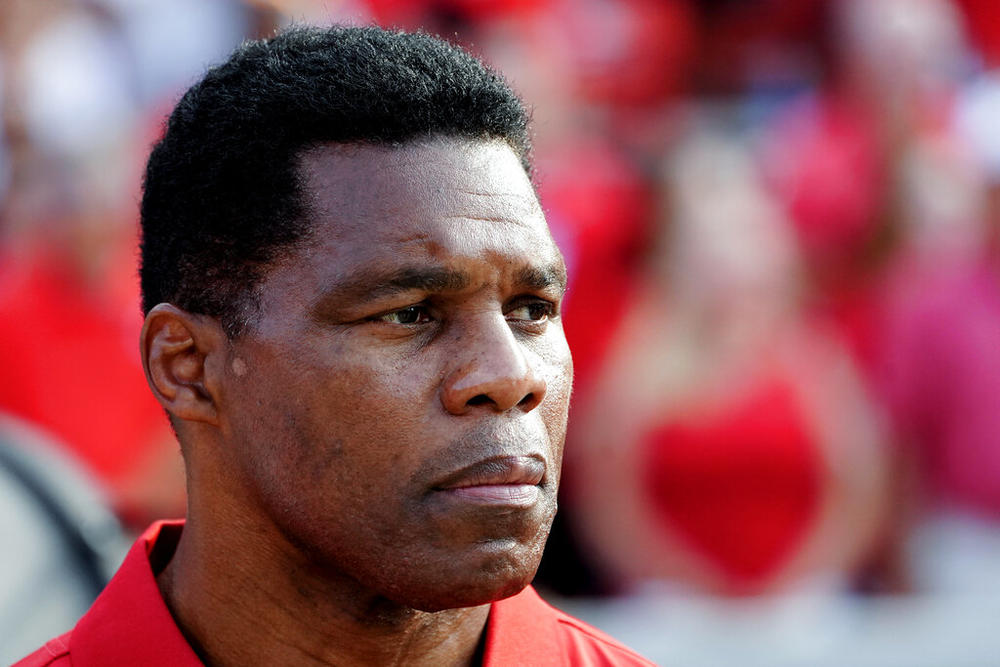
Former Georgia running back and Republican Georgia Senate candidate Herschel Walker attends a college football game between UAB and Georgia, Sept. 11, 2021, in Athens, Georgia.
Credit: AP Photo/John Bazemore, File
Former Georgia running back and Republican Georgia Senate candidate Herschel Walker attends a college football game between UAB and Georgia, Sept. 11, 2021, in Athens, Georgia.
Kurt Young, @kurtbyoung, professor of political science, Clark Atlanta University
Mark Niesse, @markniesse, reporter, The Atlanta Journal-Constitution
Patricia Soto Servin, digital content producer, The Univision 34 Atlanta
Rene Alegria, publisher, MundoNOW
1. A second woman is alleging Herschel Walker wanted her to have an abortion.
/
Rene Alegria on the second anonymous woman who alleges Herschel Walker paid for an abortion.
2. Georgia election officials are worried about voter intimidation and interference at polling places.
/
Mark Niesse on the potential for unrest during the midterms.
3. A look at Georgia's Latino electorate.
- In a poll for the Georgia News Collaborative, Latino and Hispanic voters say their top concern is unsustainable rates of inflation. They're also in favor of Herschel Walker and split on the governor's race.
- 64% of Latino voters say high prices have had a "significant, negative impact" on their daily lives, compared to the average rate of 54%. 79% of Latino respondents say cost of living is either extremely or very important to their vote.
- Latino voters seem to be split on abortion, falling along the lines of country of origin.
Rene Alegria of MundoNOW explains the generational structure of Latino communities in Georgia:
" The last census was very elucidating in that it really identified what is now about three different types of generations [of Latinos] at play ... You have the first generation (1) which are individuals that immigrated to the United States, whether undocumented or illegally. They have a very strong connection to their country of origin, wherever that may be. They're in the United States, but they really think in terms of their country of origin... Then you have the one point five generation (1.5) ... which is ... individuals who immigrated to this country as children ... So they're bilingual and bicultural. They definitely have English preferred intake of education, of media, etc.. And they're kind of a little bit of an X factor, right?...Then you have the second generation (2), which are the sons and daughters of (1) and (1.5). That's those are individuals like myself, right? Born in the United States, educated in the United States. You know, we prefer our media in English, primarily educated in English. We are fully acculturated. And with that, it informs what we do, how we spend, how we vote...Third generation (3) is my sons and daughters. Right? And they're full-on Americans."
/
Rene Alegria breaks down how generations of Latino voters may vote differently.
Friday on Political Rewind: AJC's business and economics reporter Mike Kanell and Emory professor Caroline Folin joins the panel to talk about the economy. You can leave us questions or comments on Twitter @PoliticsGPB, or leave us a voicemail (404) 494-0421.