


Section Branding
Header Content
Georgia Today: Measles & West Nile cases confirmed; Georgia Tech Mars simulation; Columbus air taxis
Primary Content
On the August 19th edition: The Georgia Department of Public Health confirms cases of measles and West Nile virus; negotiations are underway to make Columbus one of the first hubs for electric air taxis; And Georgia Tech students simulate the communication delays crews could face on a mission to Mars.
Peter Biello: Welcome to the Georgia Today podcast. Here we bring you the latest reports from the GPB newsroom. On today's episode, the Georgia Department of Public Health has confirmed cases of measles and West Nile virus in Georgia, negotiations are underway to make Columbus one of the first hubs for electric air taxis, and a group of Georgia Tech students simulate what like to communicate with astronauts on Mars.
Alan Yeung: The time it takes for a conversation from Earth to get to Mars is approximately 20 minutes. 20 minutes there, 20 minutes back. So that means it could take 40 minutes before the crew can actually tell us something that we've told them.
Peter Biello: Today is Wednesday, Aug. 19. I'm Peter Biello, and this is Georgia Today.
Story 1
Peter Biello: All eyes are on the governor and senate races in Georgia, but candidates running for statewide constitutional offices like lieutenant governor are working to engage voters as well. GPB's Sarah Kallis reports.
Sarah Kallis: Democratic lieutenant governor candidate Josh McLaurin says he believes excitement for the candidates at the top of the ticket will help voters pay attention to his race.
Josh McLaurin: And I think voters see that Democrats, from the state level to the federal level, are all rallied behind our leadership and united on the same concerns. I think that voters know when they go to the polls and they pull the lever for a Democrat right now, they're voting for the party that is not distracted.
Sarah Kallis: Republican lieutenant governor candidate Greg Dolezal said the LG race is part of a bigger picture.
Greg Dolezal: We will reclaim the state for the values upon which it was founded. We're an original colony, y'all. It's time that we act like it.
Sarah Kallis: The two candidates will face off Nov. 3. For GPB News, I'm Sarah Kallis.
Story 2
Peter Biello: The Georgia Department of Public Health has confirmed a case of measles. DPH says the case is in an unvaccinated resident in metro Atlanta without known travel history or exposure to someone infected with measles. This is the seventh confirmed case in Georgia this year. Last year, there were 10. Also, the Department of Public Health has confirmed the second case of someone contracting West Nile virus in Georgia this year; the newest case is an adult in Chatham County in Southeast Georgia. Last year the state had 18 cases. Mosquitoes have tested positive for West Nile virus in Decatur and Atlanta this year. Public health officials are urging Georgians to avoid dusk and dawn activities when mosquitoes are most active, wear bug spray, eliminate standing water, and reduce exposed skin when outside.

Story 3
Peter Biello: A group of Georgia Tech students is concluding a 10-day simulated Mars mission in Arkansas. GPB's Amanda Andrews has more from mission control on the school's campus.
Amanda Andrews: The SEA-1 Thalassa mission includes six astronauts and 30 crew in mission control. Students in the Southeast Analog Program worked in three shifts around the clock to do astronaut training, spaceflight operations, and research. Alan Yeung is a graduate student and flight director for the mission. He says they had to simulate time delays for a more realistic experience.
Alan Yeung: The time it takes for a conversation from Earth to get to Mars is approximately 20 minutes. It ranges, depending on where we are. But 20 minutes there, 20 minutes back. So that means it could take 40 minutes before the crew can actually tell us something that we've told them. And that is a huge challenge.
Amanda Andrews: This is one of the first student-led analog astronaut missions in the United States. For GPB News, I'm Amanda Andrews.

Story 4
Peter Biello: Atlanta is among the cities that may see more Amazon packages delivered by drone. The company announced today it's expanding drone deliveries to suburban areas in nearly 500 U.S. cities. Amazon says customers could receive the drone deliveries in as fast as 30 minutes. Packages can be up to 5 pounds. Other new communities in the plan include Chicago, Cleveland and Boise.
Story 5
Peter Biello: The Metro Atlanta Rapid Transit Authority has never had anyone ride it more rapidly than two college students did last week, at least officially. Students Ayush Maini and Andrew Zhang broke the Guinness World Record for the fastest time to visit every MARTA rail station. They visited 38 stations in 3 hours and 21 minutes. That's 13 minutes faster than the previous record. GPB's Orlando Montoya talked to the pair about the record and why they wanted to break it.
Ayush Maini: So when I was a kid, I discovered — I'm from New York City, and I discovered the New York City speed run. And in New York City, it's 22 hours and 14 minutes and 10 seconds. That's the current record, which is another goal of mine. It's been a lifelong dream of mine, and so to have the opportunity to come to Atlanta, where Andrew lives, and break this record with him, it has been a continuation of that dream. And to go and have the opportunity to advocate for transit while we're doing that, I think it's just a great opportunity.
Orlando Montoya: Andrew?
Andrew Zhang: Yeah, I first heard about Ayush's passion for transit. I originally wasn't as into transit as Ayush has been, but I saw a lot of the work he did and I was, quite frankly, a little inspired.
Orlando Montoya: And what are the rules for breaking this record?
Ayush Maini: So we've got to visit all of the stops in the quickest amount of time and Guinness has a very, very stringent set of requirements. So we have to go, throughout the run, we have to record the time that the doors open and close at every stop. We have get witnesses both at the beginning and the end and also throughout the runs so it gives us a chance to meet people and we've gotta record the whole thing. So we have body cam of about three hours of footage of us exploring MARTA.
Orlando Montoya: What challenges did you run into along the way?
Ayush Maini: Oh, so many challenges from — from the start to the end, you know. I think from the planning, you know, you need a system that's going to be fast, frequent and reliable to be able to execute something like this. And so for the record to be broken, I think it shows how MARTA is improving in creating fast, frequent and reliable service. We have to meet people because you have to get all those signatures, which was Andrew's job and we got to see what people thought of the system, interact with people. I'll let Andrew speak on that. It was its own unique challenge.
Andrew Zhang: Yeah. And I think, like, aside from the inherent speed running part, it's honestly a group project. It takes a lot of planning. Even though the two of us are the ones that broke the record, it takes a lots of people. So it's really kind of more of a community effort than just the two of us.
Orlando Montoya: What happened at the airport? You said something — something happened there.
Ayush Maini: Ah. We arrived, um — we had a two-minute connection there. We were an hour and a minute and 45 seconds late. But we still had 15 seconds and so we got off the train and we started sprinting there. We watched the doors close in front of our face and then I gesticulated wildly at the operator who did not open the door and left without me.
Orlando Montoya: That happens every day on MARTA to many, many commuters.
Ayush Maini: Yup. Part of the experience of MARTA as folks really do it, you know?
Orlando Montoya: This was an exceptional ride, but a lot of riders like you, Andrew, are rushing to get to places on MARTA every day. Based on your experience here, what do you think MARTA could do to make trips faster?
Andrew Zhang: I think they've already started taking steps in that direction. I think in the recent months over the summer, they've done a revamping of the gate system. They've done a lot of construction, alot of work and effort has put into that. I think a lot of it is smoothing out the process, making the entire process more streamlined, more consistent. And I think that's the direction that ultimately is where we want to see MARTA go in.
Ayush Maini: I feel like public transit, you know, like, if you're adding one line, it's one line, but what really makes public transit work is that it's a holistic system and it's made up of connections and buses and last-mile transit. And so if MARTA can tighten up those connections and make them more reliable, you know, that — that's what will really speed up the commute for a lot of people.
Orlando Montoya: Well, it's been great talking to you and congratulations, Ayush and Andrew, on your record.
Ayush Maini: Thank you. Thank you very much. Thanks for having us.
Peter Biello: Ayush Maini studies economics and psychology at Amherst College. Andrew Zhang studies physics at Georgia Tech. They spoke with GPB's Orlando Montoya on Saturday.
Story 6
Peter Biello: Negotiations are underway to make Columbus one of the first hubs for electric air taxis. Negotiators are looking at putting a universal charging station in Vertiport at the Columbus Airport. The proposal would allow for vertical takeoff of electric air taxi, which become airborne like helicopters and fly like airplanes. Advocates say these air taxis would, among other benefits, speed up delivery of organs for transplant. The Columbus Airport charging station comes with a $1 million price tag. Economic development organization Choose Columbus is working with the Columbus Consolidated Government to secure funding.
Story 7
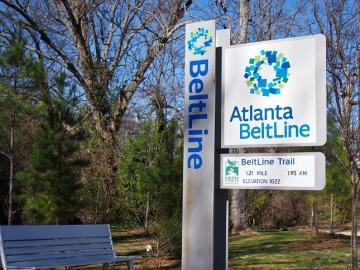
Peter Biello: Leaders of the Atlanta Beltline say they are expanding its autonomous shuttle pilot program. Launched in June, ATL Spoke established a route for the driverless shuttle between the Beltline, the West End MARTA station, and the Lee and White Commercial District. The new route starting today loops in Atlanta University Center, which will create a new connection for AUC students, faculty, and staff ahead of the fall semester. Rides are free and open to the public, with shuttles every 12 to 15 minutes, seven days a week from noon until 10 p.m.
And that is a wrap for today's edition of Georgia Today. Thanks for tuning in. Hope you come back tomorrow. Make sure you subscribe to this podcast and check gpb.org/news for new stories and updates to the stories you heard today. Your feedback is welcome, of course. Send it to us by email. The address is [email protected]. I'm Peter Biello. Thanks again for listening. We will see you tomorrow.
Support Local Journalism
GPB believes that everyone should have access to trustworthy, fact-based stories that connect them to their community and outward to the wider world. Your donation will help us in our efforts to unite and uplift Georgia.
GPB is vital. Always educational, essential, inspiring and grounding. So happy to be a supporter.
Secondary Content
Author